Call/WhatsApp: +91-9811618013, +91-9810306077
Email: keohenna@gmail.com, kirpaloverseas@gmail.com
Email: keohenna@gmail.com, kirpaloverseas@gmail.com





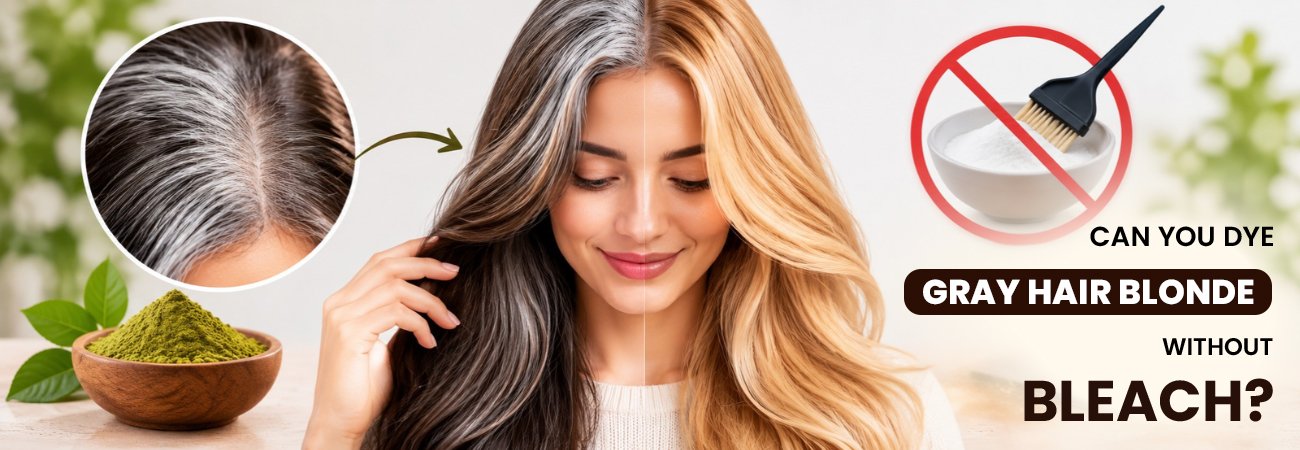
Yes, you can often dye gray hair blonde without bleach. If that’s all you came for, take it and go. If you’d like to know why it sometimes looks beautiful and sometimes turns into a flat, straw-colored mess, stay a few minutes. The difference comes down to a handful of things most hair color labels never mention.
We grow, grind, sift, and ship henna from Sojat, Rajasthan, so we get asked about this a lot, usually in a slightly hopeful tone: “Can your henna make gray hair blonde?” The honest answer to that second question is no, and we’ll explain exactly why. But the first question deserves a proper answer on its own, because it matters to anyone who colors hair, sells hair color, or is deciding which henna powder manufacturers to trust with a product line.
Picture two people asking the same thing for different reasons.
The first is a salon owner. Her client is in her sixties, mostly silver, and wants something softer and lighter. She doesn’t want the harshness of bleach, and her scalp gets irritated easily. The salon owner wants to know whether a gentle, plant-friendly route exists.
The second is a founder building a hair care label for the UK and UAE markets. Her customers search for “blonde henna” every week. She wants to launch one, and she’s asking her supplier whether it’s possible.
Both deserve a straight answer, and the straight answer is more useful than a yes. Blonde on gray is achievable. Blonde from pure henna isn’t. Once you understand why, you can choose the right product, set the right expectation, and avoid a pile of refund requests.
Hair gets its color from melanin, made by cells at the base of each follicle. Over time those cells slow down and eventually stop. The new strand that grows out has no pigment at all. It looks gray or white because it’s translucent keratin, and light scatters through it instead of being absorbed.
That has two consequences that pull in opposite directions.
There’s nothing to lift. Bleach works by breaking down existing pigment. On a gray strand, there’s none to break down. That’s why a mostly gray head can reach blonde without lightener, and why you can sometimes get away with a single step instead of two.
It doesn’t hold color well. Gray hair is often coarser and drier. The oil glands produce less sebum with age; the cuticle can be more tightly packed, and the surface can feel wiry. Color struggles to get in and then slips out in the wash. Many people notice their blonde fading to a dull yellow within weeks, or gray roots reappearing sooner than expected.
There’s a third thing worth knowing. Because a gray strand has no pigment of its own, it takes on the exact undertone of whatever you put on it. Put a cool ash blonde on it, and you can end up with a greenish or slate-gray tint. Put a warm gold on it, and it comes out clean. This is why good colorists add a warm base even when the client asks for a cool blonde.
[Add your own photo here: a close-up of henna-treated and untreated gray strands side by side. Original photos strengthen EEAT more than any paragraph.]
Before choosing a product, work out how much of the head is actually gray. Look at the hair in daylight, part it in a few places, and check the crown, the temples and the hairline separately. Gray is almost never even.
| Gray on the head | What to expect with no bleach | Best approach |
|---|---|---|
| 80 to 100 percent | A soft, slightly sheer blonde, close to the shade on the box | Permanent or demi-permanent blonde with a warm base |
| 50 to 80 percent | Blonde on the gray, a darker blend elsewhere | Permanent color plus fine highlights to even it out |
| 25 to 50 percent | A dark blonde at best, with visible contrast | Low-lift blonde blended with the natural color |
| Under 25 percent | The dark hair stays dark | A lightener is needed for blonde, or leave the grays as accents |
The golden rule sits underneath the table: dye can add color, but only a lightener can remove it. Gray hair is the one case where there’s very little to remove.
This is the workhorse. A permanent color uses an alkaline agent to open the cuticle and a developer to set the color inside the strand. For gray coverage, formulators usually combine a natural-series tone with a gold or beige tone, because that keeps the result from looking flat.
Best for: mostly gray hair that needs full, lasting coverage. Watch out for: sensitivity to ingredients like PPD and ammonia. Always patch test 48 hours before.
These are permanent tints with a stronger lifting formula. On pigmented hair they can lift a few levels without bleach powder, which makes them useful for the salt-and-pepper client.
Best for: hair with a mix of gray and light-to-medium brown. Watch out for: they have limits. They won’t take dark brown to platinum, and pushing them further risks dryness and uneven results.
Gentler, fades gradually and blends gray instead of fully covering it. Many clients like it because the regrowth line is softer.
Best for: people who want a subtle shift and a lived-in look. Watch out for: it won’t last as long and won’t fully cover resistant gray.
If the head is a true mix, working with the gray is easier than fighting it. A few fine highlights in a golden tone make the gray look intentional. Strictly speaking this uses a little lightener on the pigmented strands, but far less than a full blonde.
Best for: salt-and-pepper hair, and anyone who dreads regrowth lines.
This is where the confusion starts, so it gets its own section next.
No. And it’s worth understanding why, rather than just taking our word for it.
Henna comes from the leaves of Lawsonia inermis. When the powder is mixed with a mild acid and left to sit, it produces lawsone, a red-orange molecule that binds to the keratin in hair. Lawsone is a stain, not a lightener. It sits on top of whatever color is already there.
On dark hair, that stain hides inside the natural pigment and gives a reddish glow. On gray hair, there’s nothing for it to hide in, so you see the lawsone as it is: bright orange to copper. The color often looks lighter and more vivid at first, then deepens over the next day or two as it oxidizes. Fresh, finely milled powder gives richer results, which is a quiet reason to care about who mills it.
That’s the core of it. Henna can’t produce blonde because blonde needs a light, golden-yellow result, and lawsone doesn’t make one.
| Plant powder | What it does on gray hair | Does it give blonde? |
|---|---|---|
| Henna | Orange to copper, deepening over a day or two | No |
| Cassia obovata | A sheer straw or golden tint, plus conditioning | A faint yellow cast at best, not a true blonde |
| Indigo | Blue-black when layered over henna | No |
| Amla | Conditioning and a mild tone, used as a supporting ingredient | No |
| Chamomile | Subtle brightening on light hair, little effect on gray | No |
Be careful about putting chemical blonde dye or lightener over henna. Stylists often avoid it because the outcome can be unpredictable: patchy lift, an orange cast that won’t shift, or a reaction with leftover residue. It gets worse when the “henna” wasn’t pure. Some cheap products labeled as henna contain metallic salts or synthetic dyes, and so-called black henna often hides PPD. Real henna is never black. If a client has used henna in the past year, do a strand test first and tell them honestly what might happen.
We don’t want to leave you thinking henna is a second-best product. For covering gray, it’s one of the best things you can offer, as long as the client wants warm tones.
The tradeoffs are real too. Henna takes longer to apply and process; it’s messy, and the color is hard to remove later. It also can’t lighten. If your client wants lighter hair, henna is the wrong tool, and it’s kinder to say so at the consultation.
Cassia obovata gets sold as “neutral henna” or “blonde henna.” On light hair, it can add a golden shine and leave the hair feeling conditioned. On gray hair, it usually gives a sheer, straw-like tint that fades with washing. That’s a pleasant gloss for someone who likes a soft golden glow. It isn’t a reliable blonde, and calling it one sets customers up to be disappointed. If you stock cassia, describe it as a conditioning and tone-softening product, and show what it looks like on real gray hair.
If you run a salon or train stylists, this is the order of operations we’d follow.
Gray hair is drier and shows damage more, so aftercare matters.
If you buy or private label hair color, the gap between what customers search for and what a plant powder delivers is a positioning problem, and a commercial opportunity.
Be precise on the label. Describing henna as a blonde solution creates returns and negative reviews. Clear shade descriptions with real photos on gray hair protect your brand and your reviews.
Build a range, not a hero product. A sensible line might include pure henna for red and copper, a henna and indigo system for browns, a cassia-based conditioning treatment, and a separate ammonia-free blonde from a compatible formulator. One factory rarely does every category well, and it’s fine to say so.
Think about your channel. Salon chains want repeatable shades and clear instructions. Organic beauty distributors care about ingredient purity and certificates. Private label founders need packaging flexibility and small trial runs. The same powder can serve all three if the documentation is right.
Plan for the questions. Customers will ask about gray coverage, how long henna lasts, and whether they can lighten afterward. Put honest answers on your site and your packaging before the customer service inbox does it for you.
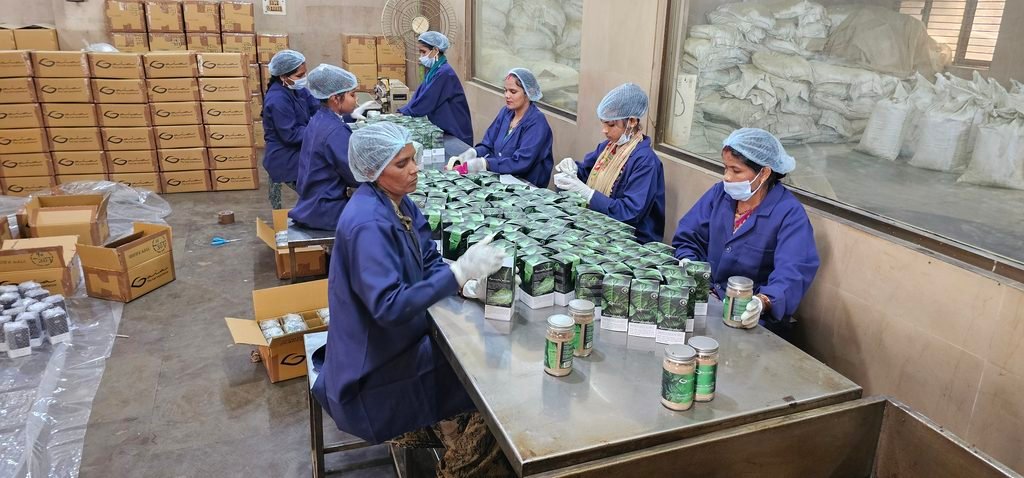
India, and Rajasthan in particular, is the center of global henna production. Sojat, where we operate, has a long association with henna cultivation and processing, helped by the dry climate and local leaf quality. But “made in India” tells you the origin, not the quality. Between henna powder manufacturers in India, the difference shows up in consistency, testing, and honesty.
Here’s what we’d ask for if we were on the buying side.
| What to check | Why it matters | What to ask for |
|---|---|---|
| Raw material sourcing | Leaf quality drives dye content and color | How leaf is sourced, graded, and stored |
| Lawsone content | It determines how strongly the powder stains | A lawsone figure per batch, from a lab |
| Fineness and sifting | Fine powder rinses clean and dyes evenly | The mesh size and a sample to feel |
| Adulteration | Metallic salts and synthetic dyes ruin results | A written statement of purity and test reports |
| Heavy metals, microbes, pesticides | Safety and regulatory acceptance | A certificate of analysis (COA) from an accredited lab |
| Packaging and shelf life | Freshness affects color strength | Packaging options, storage advice and shelf-life stated in writing |
| Customization | Private label and OEM need flexibility | Custom blends, pack sizes and label support |
| Export experience | Delays cost money | Documentation, freight experience and target-market familiarity |
And one test that costs nothing: ask for a sample and try it on gray hair, not a swatch. Any manufacturer worth working with will be glad you did.
Regulations differ by market, so check the current rules before you launch. A few points that come up often:
We’re not a regulatory consultancy, so treat this as a prompt to ask an expert for your target country, not as legal advice.
You can often dye gray hair blonde without bleach, because gray hair has little pigment to remove. It works best when most of the hair is gray, when the formula has a warm base, and when expectations are set honestly. Henna isn’t the formula for blonde. It’s one of the best formulas for covering gray in warm, natural shades while conditioning the hair.
For brands, importers and salon chains, the real opportunity is to be the supplier who tells customers the truth. That starts with choosing henna powder manufacturers who can back their claims with test reports and consistent batches. If you’d like samples, specifications or private label options for henna hair color, reach out to our team at Kirpal Export Overseas and test it on gray hair yourself.
Yes, in most cases. Gray hair has little or no melanin, so a permanent or demi-permanent blonde dye can deposit color without lightening. Results are best when most of the hair is gray. If a lot of dark hair remains, you usually need a lightener for a true blonde.
No. Henna stains gray hair orange to copper. A true blonde needs a blonde permanent or demi-permanent formula. Cassia obovata can add a light golden gloss, but it doesn’t reliably color gray hair blonde.
Usually bright orange to copper at first, deepening over a day or two. Blending with indigo moves the result toward brown. A strand test shows how it will look on your own hair.
It’s risky. Lift can be patchy and unpredictable, especially if the henna wasn’t pure. Always do a strand test and tell your stylist about any henna use.
Batch-level COA, heavy metal and microbial reports, confirmed absence of PPD and added dyes, consistent fineness, private label capability and export documentation.
Yes. India, especially Rajasthan, is a leading source of henna powder. Quality varies by supplier, so ask for test reports and samples before placing a bulk order.
Yes. We supply private label and OEM henna hair color to international buyers. Contact our team for specifications, samples and terms.
If you sell hair color, you already know the question. A customer picks up the…
Most private label henna brands don’t fail because of weak marketing. They fail because of…
Entra hoy en un salón de Milán, Berlín o Londres y notarás algo pequeño pero…
Ask ten people which hair dye brand is the safest and you’ll get ten different…