Call/WhatsApp: +91-9811618013, +91-9810306077
Email: keohenna@gmail.com, kirpaloverseas@gmail.com
Email: keohenna@gmail.com, kirpaloverseas@gmail.com





Every buyer says they want “sustainable” henna these days. Type the phrase into any B2B search bar, and you’ll get thousands of suppliers claiming the label. But ask a private label brand in Berlin or a salon distributor in Dubai what sustainability actually means to them. The answers get specific fast — water usage at the processing unit, whether the leaf was grown with synthetic fertilizer, how the powder travels from Rajasthan to their warehouse, and whether the packaging ends up in a landfill or a compost bin.
That gap between the label and the substance is exactly where sourcing decisions go wrong. So this guide skips the marketing language and walks through what eco-conscious buyers are genuinely checking before they sign a contract with henna manufacturers in India in 2026—and why so much of that scrutiny leads straight back to Sojat, Rajasthan.
Five years ago, “natural” was enough. A supplier could put a green leaf on the packaging and call it a day. That’s no longer true, and it’s not because buyers got pickier for no reason—it’s because the markets they sell into changed underneath them.
The EU’s deforestation and due-diligence regulations pushed importers to demand traceability documents they had never asked for before. Retailers in the US started requiring third-party lab reports as a condition of shelf placement, not just at onboarding. And customers themselves—the ones actually applying the henna to their hair—got a lot more comfortable reading ingredient lists and asking suppliers direct questions on Instagram.
The result is that “sustainable” stopped being a marketing adjective and became a checklist. Below is what’s actually on that checklist.
Not all henna is grown the same way, and location matters more than most first-time buyers realize. Sojat, in Rajasthan’s Pali district, has semi-arid soil and a climate that happens to produce henna leaves with unusually high lawsone content — the compound responsible for color strength. It’s the reason Sojat carries a Geographical Indication (GI) tag, similar in spirit to Champagne or Darjeeling tea.
For an eco-conscious buyer, GI-tagged origin does two things at once. It confirms the leaf wasn’t grown in a region requiring heavy irrigation or chemical intervention to survive, since henna shrubs are naturally suited to arid conditions and need comparatively little water. And it gives the buyer a paper trail—a region-specific claim they can point to in their own marketing without it being an unverifiable statement.
Buyers should ask suppliers directly: is the henna sourced from farms in the Sojat region, or is it blended with leaf from elsewhere and repackaged under a “Rajasthani” label? The difference shows up in both color performance and in how confidently the claim can survive an audit.
Sustainability audits used to stop at the factory gate. Now they start in the field.
Buyers increasingly ask about:
This last point matters more than it sounds. A manufacturer with long-term, direct relationships with Sojat farmers can control quality and consistency at the source. A manufacturer buying loose leaf through middlemen at auction has far less visibility into how that leaf was grown — and far less ability to answer a buyer’s sustainability questionnaire honestly.
This is the stage where a lot of henna quietly stops being natural, even when the label still says it is.
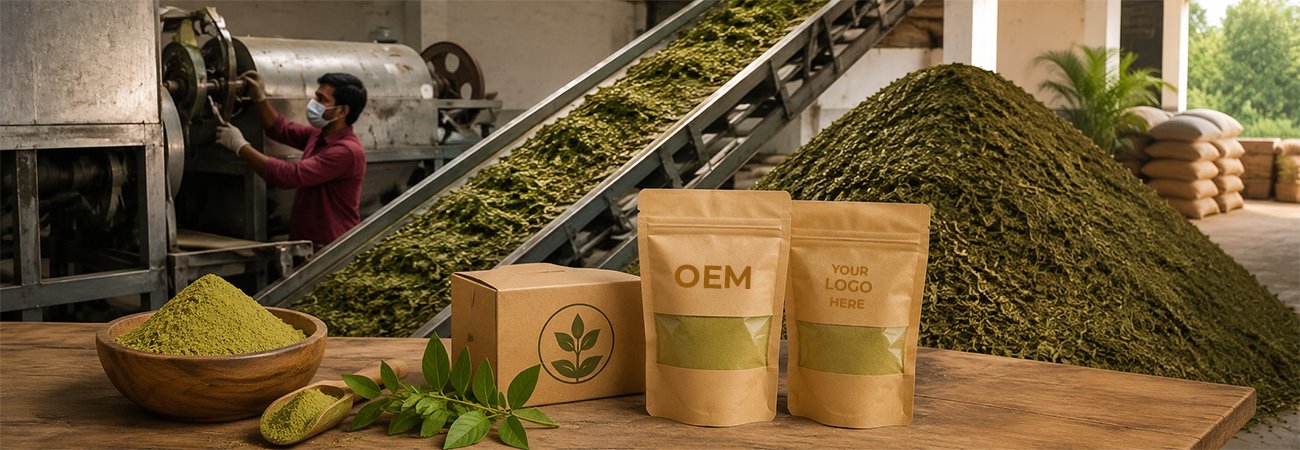
Shade drying vs. mechanical drying. Traditional Sojat processing dries harvested henna leaves in shade, away from direct heat, which preserves lawsone content without energy-intensive machinery. Some larger operations switch to mechanical dryers to speed up throughput, which increases energy consumption and can degrade dye quality if temperatures aren’t controlled.
Grinding and sieving. Stone grinding at controlled speeds keeps the powder from overheating, which again protects the active compound. Buyers sourcing for premium or therapeutic-grade positioning usually want to know the mesh size used in sieving too, since finer, cleaner sieving reduces the need for additives that improve texture artificially.
Chemical-free processing. This is the line eco-conscious buyers care about most: no PPD (para-phenylenediamine), no metallic salts, no synthetic dye boosters added during processing. A manufacturer that can walk a buyer through their processing line step by step and explain what does and doesn’t get added at each stage is signaling something a marketing page can’t — operational transparency.
Certifications are easy to list on a website and hard to verify without asking for documents. Eco-conscious buyers in 2026 are asking for the documents.
The certifications that carry real weight for henna sourcing include:
A useful gut check for buyers: ask for a batch-specific Certificate of Analysis (CoA), not a generic company brochure. A manufacturer that can produce a CoA tied to the actual lot being shipped is operating a real quality system. One that can only offer a general “we test our products” statement usually isn’t.
Sustainability conversations used to end at the product. Now buyers are just as focused on what the product ships in.
Common questions from eco-conscious importers include whether bulk henna is available in biodegradable or recyclable packaging rather than multi-layer plastic pouches, whether the manufacturer offers paper-based or compostable retail packaging for private label lines, and whether pallet and shipping materials can be minimized or reused rather than treated as single-use.
This is also where private label buyers have real leverage. A manufacturer with in-house packaging capability can usually accommodate custom eco-packaging requests — kraft paper sachets, minimal-plastic pouches, soy-based inks — far more easily than one that outsources packaging to a third party and has limited say over materials.
Traceability sounds abstract until a buyer actually needs it — during a customs inspection, a retailer audit, or a customer complaint that requires tracing a batch back to its source.
What buyers are checking here: can the manufacturer trace a finished batch back to the specific farm cluster or harvest season it came from? Is there a documented chain of custody from farm to mill to export packaging? And critically, does the manufacturer maintain this documentation as standard practice, or only produce something when a buyer specifically demands it?
Manufacturers who treat traceability as a built-in part of their process — not a one-off favor for a demanding client — tend to be the ones that survive due-diligence checks without last-minute scrambling.
This gets less attention than it should in henna sourcing conversations, but it’s increasingly part of the checklist for European and North American buyers specifically, many of whom now operate under supply chain due-diligence obligations that extend to labor conditions, not just environmental impact.
Relevant questions include whether farmers are paid fair, consistent rates rather than being at the mercy of volatile middlemen pricing, whether factory workers operate under safe conditions with reasonable hours, and whether the manufacturer can speak to this openly rather than treating it as an uncomfortable topic.
A manufacturer that has nothing to say when asked about labor conditions is not necessarily doing something wrong — but it is a gap that increasingly costs deals, particularly with retail buyers who face their own compliance reporting requirements.
This is the newest item on the checklist, and it’s growing fast. Buyers are starting to ask about the carbon cost of getting a product from Sojat to their warehouse — not because they expect a zero-emissions answer, but because they need the data for their own reporting.
Practical questions worth asking a manufacturer: do they consolidate shipments to reduce the number of partial-load freight trips, do they offer sea freight as a lower-emission alternative to air freight where timelines allow, and can they provide basic shipment data (weight, distance, mode) that a buyer’s sustainability team can plug into their own carbon accounting?
Few Indian manufacturers have full carbon-footprint reporting in place yet. But the ones already collecting this data, even informally, are positioning themselves ahead of where the market is heading.
For buyers building their own brand on top of sourced henna, sustainability has to be replicable at scale — not a one-time nice gesture from the supplier.
This means checking whether the manufacturer can maintain consistent sustainable sourcing across repeat orders, not just the first sample batch, whether formulation flexibility exists for buyers wanting to add certified-organic carrier ingredients or avoid specific excipients, and whether the manufacturer’s minimum order quantities align with a smaller sustainable brand’s actual sales velocity, rather than forcing overproduction and waste.
A manufacturer that only offers “sustainable” as a premium add-on tier, rather than as the baseline across their catalog, usually isn’t set up to support a private label brand built entirely around that positioning.
A few patterns tend to separate genuine sustainable henna manufacturers in India from suppliers using the word loosely:
Vague answers about origin, especially reluctance to name a specific growing region. Inability to produce a batch-specific lab report on request. Certifications listed on a website with no certificate numbers or issuing bodies named. No clear answer about packaging materials beyond “we can discuss it.” And pricing that’s dramatically lower than the market average for genuinely GI-tagged, lab-tested henna — since chemical-free processing, fair farmer pricing, and proper testing all cost more than cutting corners.
None of these are automatic disqualifiers on their own, but two or three together are worth pausing over before placing a large order.
A short list to bring into any sourcing conversation:
A manufacturer confident in their sustainability practices will usually answer all seven without hesitation — often with documentation ready to send the same day.
Sustainability in henna sourcing isn’t a single certificate or a line on a packaging label. It’s the sum of a dozen smaller decisions — where the leaf was grown, how it was dried, what went into the powder, how it was packed, and how honestly a manufacturer answers questions about all of it. Buyers who ask the specific questions above tend to end up with suppliers who can actually back up what they claim, rather than ones who are simply good at saying the right words.
1. What makes a henna manufacturer “sustainable”? A sustainable henna manufacturer sources leaves from low-input or organic farms, uses chemical-free processing methods like shade drying and stone grinding, tests batches for purity, and offers eco-friendly packaging with traceable supply chains—rather than simply labeling the product “natural” without supporting documentation.
2. Why does Sojat, Rajasthan, matter for sustainable henna sourcing? Sojat’s semi-arid climate is naturally suited to henna cultivation, requiring minimal irrigation and chemical intervention compared to henna grown in less suitable regions. Its GI tag also gives buyers a verifiable origin claim rather than an unsubstantiated marketing statement.
3. What certifications should I ask henna suppliers in India for? Look for BIS/IS 11142 compliance, ISO 9001 or ISO 22716 certification, and batch-specific Certificates of Analysis covering lawsone content, moisture levels, and heavy metal or microbial testing.
4. Is chemical-free henna processing more expensive? Generally, yes. Shade drying, controlled stone grinding, and third-party lab testing all add cost compared to faster mechanical processing with synthetic additives, which is one reason unusually low henna pricing can be a red flag rather than a bargain.
5. Can private label brands request sustainable packaging from Indian henna manufacturers? Many manufacturers with in-house packaging capability can accommodate requests for kraft paper sachets, minimal-plastic pouches, or compostable retail packaging, particularly for buyers placing recurring private label orders.
The patch test is the most boring step in hair colouring, and the one most…
Every natural hair color manufacturer eventually gets the same message from a buyer: “The black…
Look closely at a microbladed brow around the eighteen-month mark, and the story is usually…
A customer once told us something we still remember. She had been colouring her gray…