Call/WhatsApp: +91-9811618013, +91-9810306077
Email: keohenna@gmail.com, kirpaloverseas@gmail.com
Email: keohenna@gmail.com, kirpaloverseas@gmail.com





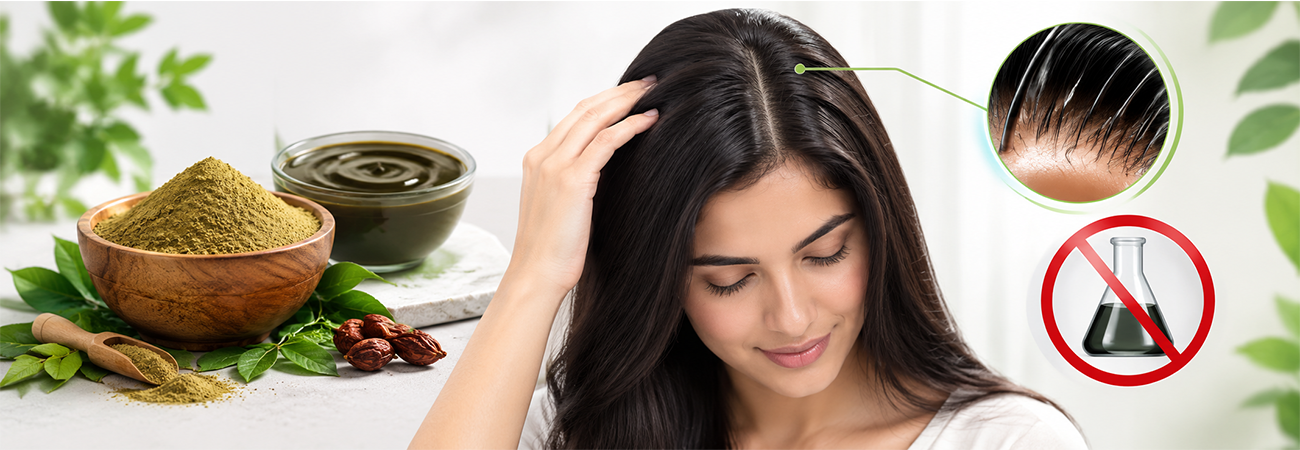
The patch test is the most boring step in hair colouring, and the one most people skip. It takes two days, it looks like nothing, and it is the only thing standing between a normal colouring session and a swollen, burning scalp.
Anyone who has had that reaction once knows why they now read every ingredient list. Many of them end up asking the same question: is there a way to colour hair without paraphenylenediamine (PPD), and is pure henna actually the answer? The short version is yes, with conditions. Those conditions depend on what is in the packet, how it was grown and processed, and who made it. That is why this article also looks at how responsible henna powder manufacturers work, because the safety of henna is decided long before it reaches your bowl or a salon chair.
For most people, including many with sensitive scalps, pure henna (Lawsonia inermis) is one of the gentlest ways to colour hair. It does not contain PPD, ammonia or peroxide. It stains the hair by binding to keratin, rather than forcing open the hair shaft with chemicals.
“Pure” is the key word. Real henna, properly processed and free of additives, has a very low rate of allergic reaction. Adulterated products sold as “henna” are a different story. Those are where most of the scary stories come from.
PPD is a dye intermediate used in many permanent and dark-shade hair colours because it produces deep, long-lasting colour. It is also one of the most common causes of allergic contact dermatitis linked to hair dye.
Here is what makes it tricky. Sensitisation is cumulative. You can colour your hair with PPD for years without trouble, then one day your immune system decides it has had enough. The next reaction can be stronger than the last. Symptoms range from an itchy, tight scalp to swelling of the face and eyelids, weeping skin and, in rare cases, a severe reaction that needs urgent medical care.
Regulators in the UK and EU limit how much PPD can be used and require warning labels on the packaging. Those rules reduce risk, but they do not remove it for someone who is already sensitised.
Not necessarily, and this is where a lot of shoppers get caught.
Many “PPD-free” dyes replace PPD with a close chemical relative, such as toluene-2,5-diamine (PTD). People who react to PPD frequently react to these substitutes too, because the molecules are similar enough for the immune system to treat them alike. A label that says “PPD-free” tells you what is missing. It does not tell you what has been added.
That is the main reason people with sensitive scalps look at plant-based options instead of reading the small print on synthetic alternatives.
Here is what we can say honestly.
What is well supported: Natural henna is widely used on hair across South Asia, the Middle East and North Africa, where it has been applied for centuries. Allergic reactions to genuine, pure henna are uncommon. Its colouring molecule, lawsone, behaves very differently from the aromatic amines that cause PPD reactions.
What needs care: “Uncommon” is not “impossible.” A small number of people do react to henna itself, and some react to other plant ingredients that are often blended into herbal hair colour, such as essential oils or added herbs. Anyone with an active scalp condition, such as eczema, psoriasis or seborrhoeic dermatitis, should speak to a doctor or dermatologist before trying anything new.
One medical flag worth knowing: Natural henna has been linked to a serious blood-cell breakdown problem in people with G6PD deficiency, particularly infants. If G6PD deficiency runs in your family, check with a doctor before using henna on a baby or small child.cc
So the honest answer is that pure henna is a strong choice for sensitive scalps, but it is not a free pass. Pure is the first filter. A patch test is the second.
This is the part that deserves more attention than it gets.
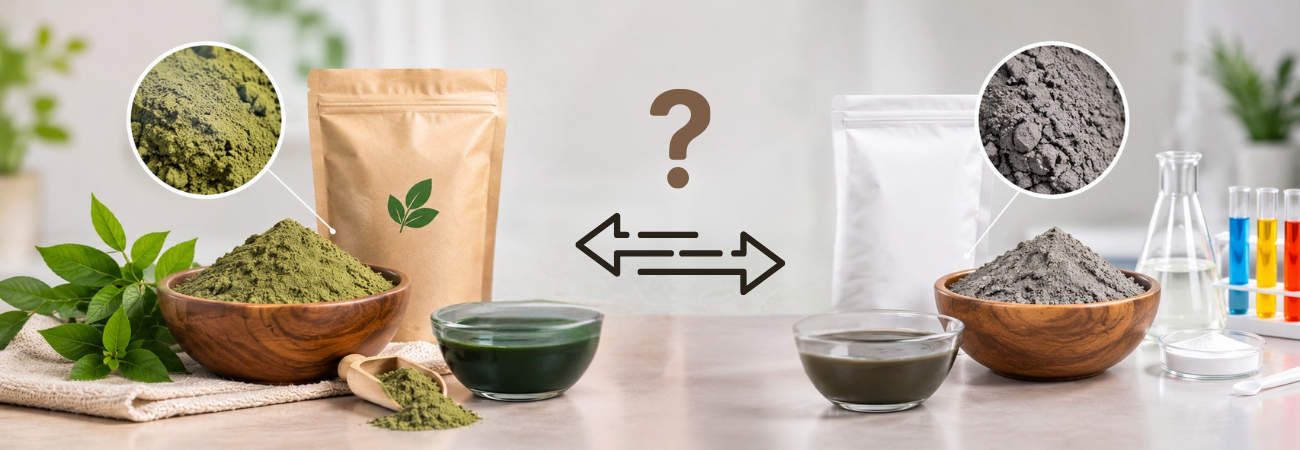
Natural henna produces shades from orange to deep copper-red. It does not produce jet-black colour on its own. When a product promises black henna in thirty minutes, the colour is almost certainly coming from something else, and that something else is often PPD.
“Black henna” is the worst offender. It has been linked to severe skin reactions, particularly when applied to skin as temporary tattoos. It is not henna in any meaningful sense, and it is the reason many people now fear the word “henna” altogether.
Other common problems in low-quality henna powder include:
A packet can look green, smell earthy and still contain none of the good things you wanted. This is why the source matters as much as the plant.
| Conventional PPD dye | Synthetic “PPD-free” dye | Pure henna | |
|---|---|---|---|
| Colour range | Wide | Wide | Red to copper; darker with other plants |
| PPD content | Yes | No, but may contain similar compounds | No |
| Ammonia/peroxide | Usually yes | Often yes | No |
| Cross-reaction risk for PPD-allergic users | High | Possible | Very low for pure henna |
| Conditioning effect | Little to none | Little | Coats the hair and adds shine |
| Quality varies by maker | Somewhat | Somewhat | Heavily, so source matters |
That last row is the one that connects safety to sourcing.
Even with pure henna, a patch test is worth the effort. Do it like this:
If you are mixing henna with other herbs such as indigo, amla or cassia, test the finished mix. A reaction to one added ingredient looks identical to a reaction to henna.
This is the part most consumers never see, and the reason two packets labelled “100% natural henna” can behave very differently on your scalp.
Responsible henna powder manufacturers treat quality control as a sequence of checks rather than one test at the end.
Raw material selection. Henna leaves vary by growing region, soil, harvest timing and weather. The best colour and the cleanest raw material come from well-managed farms, harvested at the right stage and dried properly.
Drying and cleaning. Leaves dried in uncontrolled conditions pick up dust, mould and moisture. Clean drying keeps the dye content stable and the microbial load low.
Milling and sifting. A fine, evenly sifted powder mixes smoothly and releases dye predictably. Coarse particles cause patchy colour and can irritate a sensitive scalp mechanically.
Lawsone testing. Lawsone is the dye molecule in henna. Testing for lawsone content tells a buyer how strong the batch is, and whether the powder is mostly henna or mostly filler.
Screening for contaminants. Reliable manufacturers check for synthetic dyes, PPD, heavy metals and microbial contamination, and keep records of what they find.
Documentation. A Certificate of Analysis for each batch, along with product safety documentation, is what allows a buyer to verify the product rather than trust the label. In India, the standard that applies to henna quality is IS 11142 (BIS).
If you are a salon owner, importer or brand deciding where to buy, these are the questions that separate a manufacturer from a reseller who simply repackages whatever was cheapest that month.
Sojat, in Rajasthan, India, has been associated with henna cultivation and processing for generations, and its henna holds a Geographical Indication (GI) tag. Climate and soil in the region produce leaves with strong dye content, and the local industry has decades of experience in drying and milling.
A GI tag does not guarantee that every packet is good. It does mean the origin is protected and traceable, which is a useful starting point when you are checking where your henna comes from.
Kirpal Export Overseas (KEO) is a henna powder manufacturer and exporter based in Sojat, Rajasthan. The company works with Sojat-origin henna and supplies natural henna powder and herbal hair colour products to buyers around the world.
For readers who care about sensitive-scalp safety, a few things stand out.
For a brand selling to sensitive-scalp customers, that combination matters. Pure henna from a traceable source, backed by paperwork, is a far safer foundation than a bargain product with no paper trail.
Pure henna is gentle, but a few groups should take extra care.
In all of these cases, ask a doctor or dermatologist rather than guessing.
If you are sourcing henna powder for resale, local rules matter, and they differ from country to country.
A reliable manufacturer will not dodge these questions. If a supplier cannot tell you what is in the product, where it comes from and what tests were run, that is your answer.
Henna has been used on hair for thousands of years, and for people trying to leave PPD behind, it remains one of the most sensible places to start. It will not give you every shade, and it asks for a little more patience than a box dye. In return, it colours, conditions and leaves out the chemicals that sent many people looking for an alternative in the first place.
Choose a genuine product, do the patch test, and be wary of any “henna” that promises miracles. If you are buying in bulk, work directly with established henna powder manufacturers who can show you exactly what is in each batch.
Every natural hair color manufacturer eventually gets the same message from a buyer: “The black…
Look closely at a microbladed brow around the eighteen-month mark, and the story is usually…
A customer once told us something we still remember. She had been colouring her gray…
Betreten Sie eine Drogerie in Berlin, Paris oder Mailand, finden Sie im selben Regal zwei…