Call/WhatsApp: +91-9811618013, +91-9810306077
Email: keohenna@gmail.com, kirpaloverseas@gmail.com
Email: keohenna@gmail.com, kirpaloverseas@gmail.com





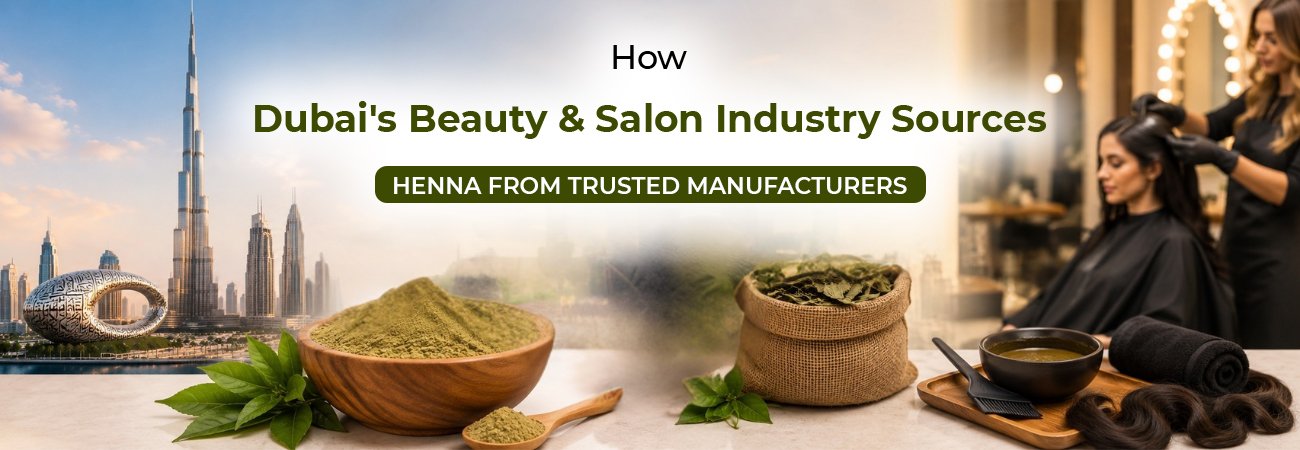
Walk into a salon in Dubai Marina, a beauty souk stall in Deira, or a spa in Abu Dhabi or Sharjah, and you’ll notice something: the henna on the shelf rarely says “made in the UAE.” It says Rajasthan. Or India. Or, if the packaging is honest about it, Sojat — a small town most customers have never heard of, but that quietly supplies a large share of the world’s henna.
That gap between “sold in the UAE” and “sourced from India” is exactly where the real work happens. The UAE’s beauty and salon industry doesn’t grow its own henna — it imports nearly all of it, across every emirate — so the entire quality story rests on who’s picking the supplier back in India. Get that sourcing decision right, and a salon or brand builds a reputation for rich, consistent color. Get it wrong, and you’re dealing with allergic reactions, inconsistent batches, and customers who don’t come back.
This article looks at how that sourcing actually works — what salons, distributors, and private-label brands across the UAE check before they commit to a supplier, and why manufacturers like Kirpal Export Overseas have become a reference point for buyers who’ve been burned by unreliable trading middlemen before.
Henna — the Lawsonia inermis plant — needs a hot, dry climate with very specific soil conditions to produce leaves with a high dye content. The UAE’s desert climate looks similar on paper, but the plant simply isn’t cultivated there at any commercial scale, whether in Dubai, Abu Dhabi, Sharjah, or the northern emirates. Practically all the henna used across the UAE’s salons, beauty retailers, and hair color brands is imported, and the overwhelming majority of that comes from India — specifically the Sojat belt in Rajasthan, which has held a Geographical Indication (GI) tag since 2016 for its henna cultivation.
This matters more than it sounds like it should. When a market has zero domestic production, the entire supply chain integrity depends on trust placed in overseas manufacturers. A salon owner in Dubai or a beauty distributor in Abu Dhabi can’t drive out to the farm and check the crop. They’re relying on documentation, lab reports, and a manufacturer’s word — which is exactly why sourcing decisions across the UAE’s beauty industry tend to be slow, cautious, and relationship-driven rather than transactional.
One pattern that’s changed over the last few years: buyers across the UAE have gotten sharper about who they’re actually dealing with.
A lot of henna listed on B2B marketplaces is sold by traders — companies that buy finished henna powder from small processing units, repackage it under their own brand, and sell it forward. There’s nothing inherently dishonest about that model, but it adds a layer between the buyer and the actual production process. If something goes wrong with a batch — inconsistent particle size, a failed lead test, contamination — the trader often can’t tell you why, because they didn’t process it themselves.
A true manufacturer controls the chain from leaf to packed product: sourcing or growing the raw henna, drying it, grinding it to a consistent mesh size, sieving out stems and debris, testing it, and packaging it under controlled conditions. That’s a meaningfully different level of accountability, and it’s the distinction the UAE’s more established salon chains and private-label buyers now ask about directly during supplier calls — whether they’re based in Dubai, Abu Dhabi, or elsewhere in the country.
“Export quality” gets thrown around loosely in henna marketing, so it’s worth being specific about what it should actually involve when a shipment is headed anywhere in the UAE.
Compliance with IS 11142. This is the Bureau of Indian Standards specification for henna powder — covering moisture content, ash content, coloring matter, and the absence of harmful additives. Manufacturers who test against this standard aren’t just checking a box; they’re giving buyers a documented baseline to compare batches against over time.
Heavy metal and microbial testing. Because henna touches skin and scalp directly, testing for lead, arsenic, and microbial contamination isn’t optional for any manufacturer serious about export markets, especially the UAE and EU, where cosmetic import regulations have gotten stricter in recent years.
Particle consistency. Salons care about this one a lot, and it rarely gets discussed in generic henna marketing. Coarse, unevenly ground henna doesn’t release color evenly and is harder to work with during application — it affects how the paste mixes, how it sits on hair, and how the final tone develops. A consistent 100-120 mesh grind (or finer, depending on the product line) is what professional users actually want.
Batch traceability. Can the manufacturer tell you which harvest lot a given shipment came from? This sounds like a small thing until a customer has a reaction and the salon needs to know exactly what was used, when, and from where.
Proper export documentation. Phytosanitary certificates, certificates of origin, MSDS sheets where required, and packaging that meets UAE import labeling requirements across all emirates. Buyers who’ve dealt with incomplete paperwork at customs before know exactly how much this one matters.
Kirpal Export Overseas (KEO) is a henna powder and herbal hair color manufacturer based in Sojat, Rajasthan — the same GI-tagged belt that supplies most of the world’s henna. That location isn’t incidental to how they operate. Being based directly in Sojat means shorter supply chains from farm to processing unit, closer oversight of raw material sourcing, and none of the added cost or ambiguity that comes from buying through a middle layer of traders.
What tends to stand out to buyers evaluating KEO against other listed suppliers is that they operate as an actual manufacturer rather than a repackaging trader — meaning the processing, quality testing, and packaging happen under their own oversight rather than being outsourced to a third party they don’t control. For a UAE-based buyer trying to build a reliable supply relationship, that’s the difference between a supplier who can answer detailed questions about a specific batch and one who has to check with someone else first.
KEO’s export quality work centers on a few consistent practices: testing raw henna leaves before processing, controlling moisture and grind consistency during production, and preparing shipments with the documentation UAE importers actually need — whether the destination port is Jebel Ali, Khalifa Port, or elsewhere — rather than generic paperwork that has to be chased down after an order is placed. For private label and OEM buyers specifically, that means formulation support and packaging flexibility are handled as part of the sourcing conversation, not as an afterthought once a container is already booked.
None of this makes KEO unique in claiming to be quality-focused — most manufacturers say that. What matters for a buyer anywhere in the UAE is whether those claims hold up when you ask for a certificate of analysis, request a sample batch before committing to volume, or ask specific questions about the harvest season a shipment came from. That’s the level of scrutiny serious salon chains and beauty distributors across the country have started applying, and it’s a reasonable bar for any manufacturer to be able to meet.
Talk to procurement teams at salon chains or private-label beauty brands operating across the UAE, and a fairly consistent checklist emerges:
The UAE’s beauty industry has matured past the stage of grabbing the cheapest henna listing on an online marketplace and hoping for consistency. Salon owners, distributors, and private-label brands across Dubai, Abu Dhabi, and the wider UAE who’ve been through a bad batch — allergic reactions, uneven color, a shipment that didn’t clear customs cleanly — tend to shift toward long-term supplier relationships instead of one-off purchases.
That shift favors manufacturers who are set up for it: ones based directly in the growing region, with in-house processing and testing, and the documentation ready before a buyer even has to ask. It’s a slower way to build a supply chain than clicking “order” on a marketplace listing, but for a product that goes directly onto a client’s scalp, it’s the approach that actually protects a business’s reputation.
For the UAE’s beauty and salon sector, the henna itself will keep coming from the same place it always has — Rajasthan’s Sojat belt. The real differentiator, increasingly, is which manufacturer on the other end of that supply chain a buyer chooses to trust.
Q1: Why doesn’t the UAE produce its own henna despite having a suitable desert climate? Henna needs specific soil and cultivation conditions beyond just heat, and there’s no commercial-scale cultivation infrastructure anywhere in the UAE. Nearly all henna used across the country’s salons and beauty market is imported, primarily from India’s Sojat region in Rajasthan.
Q2: What’s the difference between a henna manufacturer and a henna trader? A manufacturer controls the full production process — sourcing raw leaves, drying, grinding, testing, and packaging — under their own oversight. A trader typically buys finished henna powder from other processors and resells it under their own branding, without direct control over how it was made.
Q3: What certifications should UAE buyers ask for when sourcing henna? Compliance with IS 11142 (the Bureau of Indian Standards specification for henna powder), heavy metal and microbial test reports, and proper export documentation including certificates of origin and phytosanitary certificates.
Q4: Can UAE salons get private label henna and herbal hair color products? Yes, many manufacturers based in Sojat, including Kirpal Export Overseas, offer private label and OEM services covering formulation and packaging, which lets salons and beauty brands across the UAE sell products under their own branding.
Q5: How can a UAE buyer verify henna quality before placing a large order? Requesting a sample batch for testing before committing to volume, asking for a certificate of analysis, and speaking directly with the manufacturer about batch traceability are the standard steps buyers across the UAE market take before signing a supply agreement.
The patch test is the most boring step in hair colouring, and the one most…
Every natural hair color manufacturer eventually gets the same message from a buyer: “The black…
Look closely at a microbladed brow around the eighteen-month mark, and the story is usually…
A customer once told us something we still remember. She had been colouring her gray…