Call/WhatsApp: +91-9811618013, +91-9810306077
Email: keohenna@gmail.com, kirpaloverseas@gmail.com
Email: keohenna@gmail.com, kirpaloverseas@gmail.com





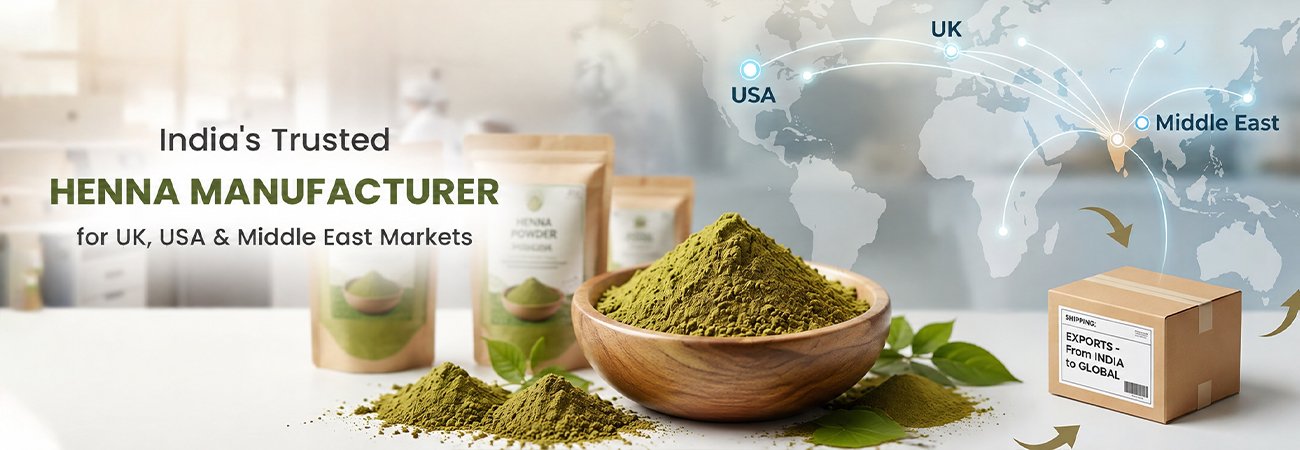
Walk into any herbal beauty store in London, browse through an organic hair care brand in Texas, or visit a traditional attar shop in Dubai — chances are, the henna in those products was grown and processed somewhere in Rajasthan, India.
That’s not a marketing claim. That’s just how the global henna supply chain works.
India has been producing henna for centuries, and Rajasthan — specifically a small town called Sojat — sits at the very center of it. This is where Kirpal Export Overseas is based. Not in a metro city office, not in a third-party warehouse. Right here in Sojat, where the henna actually comes from.
If you’re sourcing henna manufacturers in India for your brand, for wholesale import, or for a private label launch — read this before you make any decisions. It’ll save you time.
Let’s be honest about something. A lot of countries grow henna. Pakistan does. Sudan does. Morocco does.
But none of them come close to what Rajasthan produces — in volume, in quality, or in consistency.
The reason is purely geographical. The semi-arid climate, red sandy soil, and dry heat of this region create conditions that bring out the highest lawsone content in the henna plant (Lawsonia inermis). Lawsone is the compound responsible for dye release — the higher it is, the richer and longer-lasting the color.
When buyers source from low-quality henna suppliers, the first complaint they hear from their customers is inconsistency. One batch gives deep color, the next barely stains. That’s what happens when the raw material quality isn’t controlled from the farm level.
At Kirpal Export Overseas, we source directly from Sojat farms. We process in-house. There are no middlemen between the plant and the finished powder. That’s why buyers who come to us once tend to stay.
There are dozens — maybe hundreds — of henna exporters operating out of Rajasthan. We’re not going to pretend otherwise.
But here’s the thing: most of them are traders, not manufacturers. They buy processed powder from the mandi, rebag it, and ship it out. There’s no quality control. No formulation capability. No compliance documentation. Just powder in a bag.
We do this differently.
We start at the source. Our henna is exclusively Sojat-origin. We don’t blend in cheaper varieties from other regions to cut costs. What you get is what it says on the label.
We formulate in-house. If you need a specific hair color shade — dark brown with a warm tone, black with blue undertones, burgundy with conditioning actives — our team works with you on that. This isn’t something most henna exporters can offer.
We handle compliance. FDA documentation for the US. CPSR paperwork for the UK and EU. Halal certification for Middle East markets. REACH conformity for European importers. We deal with this regularly — it’s not new territory for us.
We’re flexible on quantities. Not everyone is placing a 20-ton container order on the first inquiry. We’ve worked with brands that started with small trial orders and scaled to full container shipments over time. That growth path is one we actively support.
We do full private label. Formulation, packaging, label design, language variants — the whole thing. You provide the brand brief, we handle the rest.
Most people come to us asking for henna powder. That’s where we started too. But over the years, the product range has grown considerably.
This is the foundation. 100% Lawsonia inermis, sifted and processed to different mesh grades depending on the application — hair coloring, body art, or cosmetic formulation. Clean, green, and potent.
This is honestly where we’ve put the most effort in recent years. We’ve developed herbal hair color formulations that use henna as a base and combine it with botanicals like amla, indigo, brahmi, bhringraj, and shikakai to create specific color results.
No PPD. No ammonia. No synthetic dyes.
These blends have found strong demand particularly in the UK and Germany, where clean beauty isn’t a trend anymore — it’s an expectation. Customers there read ingredient lists. They know what PPD is. They specifically look for products without it.
We’ve also expanded into ready-format products — sachets, kits, and bulk powder formats designed for cosmetic brands who want to launch their own herbal hair color line without building their own manufacturing setup.
This positions us as more than a raw material supplier. We’re a manufacturing partner for brands.
We’ve been exporting long enough to know that a buyer in Birmingham and a buyer in Riyadh have completely different requirements — even if they’re both ordering herbal hair color.
Post-Brexit compliance is a real headache for many importers. UK buyers need a responsible person based in the UK, CPSR documentation, and labeling that complies with EU Cosmetics Regulation EC 1223/2009 (which the UK still largely mirrors).
We’ve dealt with this enough times that we know what documentation you’ll need before you even ask. We also connect buyers with approved UK Responsible Persons when required.
FDA labeling requirements, INCI ingredient declarations, country-of-origin labeling, and 21 CFR Part 701 compliance—these are baselines. We provide all of this as standard with export orders to the US.
Halal certification isn’t optional for this market — it’s the first question buyers ask. We hold Halal certification, and we provide the documentation required by UAE, Saudi, and Kuwaiti regulatory bodies. For private label orders, Arabic-language label versions are available.
Something has shifted in the natural beauty space over the last few years. More brands — from small indie labels to mid-size retail chains — have realized they don’t need to own a manufacturing facility to launch their own herbal hair color line.
What they need is the right manufacturing partner.
Working with us means you don’t spend six months on R&D testing formulations. You don’t hire a regulatory consultant to navigate UK or EU paperwork from scratch. You don’t worry about whether your supplier will deliver the same quality on the third batch as they did on the first.
You pick a formulation from what we’ve already developed and tested, brief us on your brand’s packaging vision, and place your order. We handle everything from production to export documentation.
That’s the model more and more international brands are moving toward. And it’s why finding genuine henna manufacturers in India who can also function as a full private label partner matters so much.
We get this question a lot, especially from buyers who haven’t imported from India before. So here’s exactly how it works when you order from us.
Inquiry stage — You reach out via our website or email with your requirements: product type, quantity, target market, certifications needed, and packaging preferences.
Sample dispatch — We send samples within 3–5 business days. Most buyers evaluate and come back to us within 2–3 weeks.
Proforma invoice — Once you’re happy with the samples, we raise a PI. Payment terms are finalized at this stage based on order size and relationship.
Production & QC — Manufacturing begins after order confirmation. Every batch is tested internally before it goes into packaging.
Export documentation — We prepare everything: Certificate of Origin, MSDS, COA, phytosanitary certificate if required, and any certification-specific documents (Halal, organic, etc.).
Shipment — Orders go out via sea freight (FCL or LCL) or air freight, depending on urgency. We work with established freight forwarders who handle the UK, USA, UAE, and European routes regularly.
If you’ve done any research on henna sourcing, you’ve probably come across the name Sojat already. It’s hard to miss.
Located in Rajasthan’s Pali district, Sojat has earned the title “Henna Capital of the World” for good reason. Its wholesale market — the henna mandi — processes enormous quantities of raw henna leaves every harvest season. The henna that comes out of Sojat has a distinctive natural green color, fine texture, and lawsone content that other regions simply don’t match.
Being based here isn’t just a geographic detail for us. It gives us something that exporters operating out of Delhi or Mumbai warehouses genuinely can’t offer — direct supply chain visibility, farm-to-export traceability, and the ability to act quickly when buyers need custom quantities or urgent orders.
At the end of the day, the henna manufacturer you choose becomes a reflection of your brand. Your customers experience the product — not the supply chain behind it.
Kirpal Export Overseas has built its export operation around one principle: give international buyers a reason to keep coming back. Consistent quality, honest communication, proper documentation, and the manufacturing flexibility to grow with your brand.
Whether you’re a new label placing your first international order, or an established importer looking to replace a supplier that’s been letting you down — we’d genuinely like to hear from you.
Reach out to our export team at Kirpal Export Overseas. Samples, pricing, and our full product catalog are ready to go.
FAQs
Q1. What is the minimum order quantity for henna powder export from Kirpal Export Overseas?
We offer flexible MOQs depending on the product and packaging type. For bulk henna powder, the minimum is typically 100 kg. For private label sachet packing, MOQs may vary — contact us for product-specific details.
Q2. Do you provide Halal-certified henna products for Middle East markets?
Yes. Our manufacturing unit holds Halal certification, and we can provide the relevant documentation required by Gulf and Middle East regulatory bodies for import clearance.
Q3. Can you manufacture herbal hair color under my brand name (private label)?
Absolutely. We offer full private label and OEM services — including custom formulation, packaging design, and label printing in multiple languages.
Q4. What certifications do you hold for export to the UK and EU?
We provide CPSR-ready documentation, INCI ingredient declarations, MSDS, and Certificate of Analysis. For UK-specific requirements, we assist buyers with connecting to approved Responsible Persons.
Q5. How long does it take to receive samples before placing a bulk order?
Sample dispatch typically takes 3–5 business days after receiving your inquiry. International delivery via courier takes 5–10 working days, depending on the destination country.
The patch test is the most boring step in hair colouring, and the one most…
Every natural hair color manufacturer eventually gets the same message from a buyer: “The black…
Look closely at a microbladed brow around the eighteen-month mark, and the story is usually…
A customer once told us something we still remember. She had been colouring her gray…