Call/WhatsApp: +91-9811618013, +91-9810306077
Email: keohenna@gmail.com, kirpaloverseas@gmail.com
Email: keohenna@gmail.com, kirpaloverseas@gmail.com





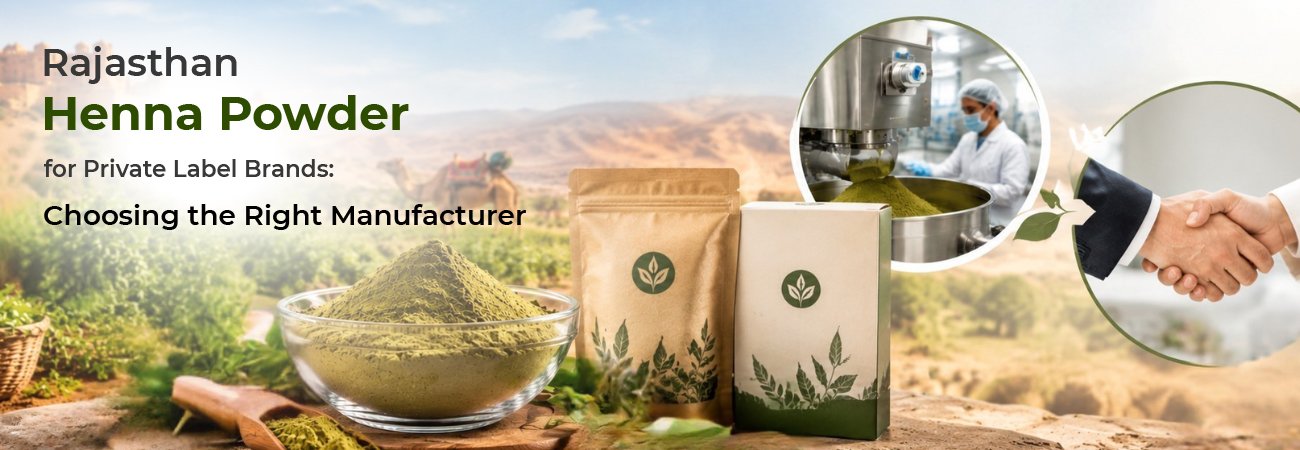
Most private label henna brands don’t fail because of weak marketing. They fail because of one decision made in the first few weeks: choosing the supplier with the nicest sample and the lowest quote.
Picture how it usually goes. A new brand, say in Birmingham or Dubai, gets three quotes from Rajasthan. One is clearly cheaper. The sample arrives; it looks good; the first order ships. Then the second batch lands a shade lighter than the first. The powder feels a little gritty. A few pouches have leaked in transit. And somewhere a customer posts a review saying her hair turned orange and stayed that way.
The brand blames the customer. The customer blames the brand. Nobody goes back to the real cause, which is that the manufacturer was never properly checked.
This guide is for anyone planning to launch or expand a henna or herbal hair color line using Rajasthan henna powder. It covers why the region has its reputation, what private label really involves, which quality checks are worth your time, what documents to ask for, and the mistakes I see brands make again and again. It is long on purpose. Sourcing is the one part of this business that is very hard to fix after you’ve printed ten thousand pouches.
Ask an importer in London or Dubai where good henna comes from, and you will usually hear one word: Rajasthan. More precisely, you’ll hear about Sojat, a town in the Pali district that has been tied to henna for generations. People call it the henna capital of India, and a large share of the country’s henna is grown, dried, milled, and traded in and around this belt.
There are practical reasons behind that reputation, not just tradition.
Now the part brochures leave out. The same ecosystem that makes Sojat great also makes it easy to resell. A trader can buy powder from two or three mills, blend it, print a polished website, and call himself a manufacturer. Nothing illegal about that. But it matters, because a trader can’t tell you what happened to the leaf before it reached him, and he can’t promise that lot five will match lot one.
Origin gets you into the room. It doesn’t tell you who you’re dealing with once you’re inside.
“Private label” sounds simple: pick a product, put your logo on it, and sell it. In practice there are three quite different models, and mixing them up is a common source of disappointment.
| Model | What it means | Suits | Watch out for |
|---|---|---|---|
| Ready product, your brand | The manufacturer’s existing henna or henna blend, packed in your pouch with your artwork | A first launch, or testing a market cheaply | Other brands may be selling the same powder, so you compete on branding and service. |
| Custom blend (OEM) | Your shade, ratios, mesh size and instructions, developed with the manufacturer | Brands that want a product nobody else has | Higher MOQ, longer development, and you need clarity on who owns the formula. |
| Bulk supply, you repack | Powder shipped in bulk and packed in your own country | Brands with their own packing line | Hygiene, testing, and labelling responsibility shift to you. |
None of these is automatically better. It depends on how much cash, time and risk you can carry.
What I would push back on is the idea that private label is “just packaging.” When your name is on the pouch, a customer’s bad result is your problem, no matter where the powder was milled. You are borrowing a factory’s skill, its testing, and its paperwork, and you are lending it your reputation. Choose accordingly.
The quality that matters most here is also the least glamorous: consistency. Anyone can send one excellent sample. The real test of a manufacturer is whether your fifth order matches your first.
“Henna” covers very different products. A good manufacturer will ask which one you want in the first call. If they don’t ask, that tells you something.
Pure henna powder. One ingredient, red-orange tones on hair, is popular with clean beauty and salon buyers. On a label in many markets it appears as Lawsonia Inermis Leaf Powder.
Henna-based hair color. Henna combined with indigo (Indigofera tinctoria leaf powder) or other herbal ingredients to reach brown and black shades. This is where formulation skill shows, because ratios, processing, and application instructions all change the final color.
Body art (mehndi) grade. Extra-fine powder is meant for cones and paste, with different sieving and different expectations.
Two honest points here, because they decide whether your customers come back.
First, pure henna on its own will not turn grey hair black or dark brown. It gives warm red to orange tones, and the color deepens over a day or two after rinsing. Brands that imply otherwise get returns and angry reviews. Be straight in your shade chart and instructions, and explain the two-step method with indigo if that is what your customer needs.
Second, the rules are not the same for hair and skin or for every country. In the US, for example, the FDA has only approved henna as a hair dye, not for decorating skin. The EU and UK expect a responsible person, a safety assessment, and product registration before a cosmetic goes on sale. Rules on specific coloring ingredients can also change. I’m not a regulatory consultant, and neither is your manufacturer, so take advice for your target market before you finalize claims and labels.
Price is the loudest number in any quotation and usually the least useful one. These checks are where the real differences between suppliers show up.
Lawson is the natural pigment that stains hair and skin, and it’s what gives henna its color. A supplier should be able to tell you how they assess dye content and which method they use. Don’t rely on a figure alone, because numbers from different methods aren’t comparable. Ask for a shade test on a hair swatch, not just a photo with flattering light.
Grit is the most common complaint about poor henna. Good private label powder is finely milled and sieved, with a smooth feel and no stalk or fibre bits. Ask what mesh the product is sieved to and how often the sieves are checked. Finer powder mixes smoother, rinses cleaner, and simply feels more premium in the hand.
You can learn a lot with your eyes and nose before any lab gets involved. Natural henna is usually an olive to brownish green. Powder that is unnaturally bright green or oddly uniform deserves a question. Fresh henna smells earthy and grassy. A musty or sour smell points to old stock or moisture. It should feel dry and silky, not clumpy.
This one is non-negotiable. Some cheap henna on the market is cut with fillers or synthetic dyes, and so-called “black henna” can contain PPD (para-phenylenediamine), which can cause serious allergic reactions. Ask directly how the supplier confirms the powder is free of synthetic dyes, and ask to see the report. A vague answer is an answer.
Henna is an agricultural product, so contamination is a real risk, not a theoretical one. A serious manufacturer tests for heavy metals, pesticide residues, and microbial load and can show recent results from an accredited laboratory. In India, look for labs accredited by NABL under ISO/IEC 17025. “We’ve never had a complaint” is not a test result.
Often forgotten, and it shouldn’t be. Moisture drives clumping, mold risk, and shelf life. A supplier who tracks moisture at dispatch is one who understands why powder that was fine in Sojat can arrive damaged after weeks in a humid container.
Ask how color, fineness, and aroma are kept steady from one lot to the next. Good answers involve blending to a written standard, retained samples from every lot, and batch numbers that let you trace any pouch back to its production date. If the answer is “our quality is always the same,” ask again, politely, and wait.
Because henna goes on skin and hair, how it’s handled matters. Ask where it is packed, how the area is cleaned, and whether the powder is treated to reduce microbes. Steam-based treatment is common. Some chemical treatments, such as ethylene oxide, are restricted in the EU and several other markets, so buyers there often ask for it to be ruled out in writing.
You don’t need a lab for a first impression. Mix a small amount of each sample into a yogurt-thick paste with a mildly acidic liquid such as diluted lemon juice or tea water. Cover it and let it rest for several hours. Apply it to a clean hair swatch from your target customer’s hair type, and note the color after one, two, and three hours. Rinse, let the swatch dry, and check again after 24 and 48 hours, because henna keeps darkening as it oxidises. Photograph everything in the same light. Do the same for every supplier on your shortlist, and you’ll have a comparison that no quotation can give you.
A professional exporter shouldn’t make you chase documents. But a pile of PDFs only helps if you know what each one proves and what to look for inside it.
| Document | What it proves | What to check |
|---|---|---|
| Certificate of Analysis (COA) | The tested values of one specific batch | Batch number and date match your order, and the lab or signatory is named |
| Safety Data Sheet (SDS) | Handling, storage, and hazard information | Issued for this product, not a generic template |
| Product specification | What the manufacturer promises on every lot | Mesh, moisture, color, shelf life and test limits are written down |
| Lab reports | Heavy metals, microbes, pesticide residues, adulterant checks | Accredited lab, recent date, the sample was your product |
| Certificate of Origin | Where the goods come from | Issued by the proper body and consistent with the invoice |
| Export paperwork | That the seller can legally ship | Valid Importer Exporter Code (IEC), invoice and packing list that match each other |
| Quality or management certificates | A system exists, not just a good week | [add the certifications your factory actually holds] |
Two cautions. A certificate only counts if it matches the batch you are buying, so read the dates and numbers. And no certificate removes your own responsibility in the country where you sell. For the EU, UK, and US, the brand or its appointed representative generally carries the legal duty for safety assessment, labelling, and registration. Your manufacturer can supply the technical data. Ask them what they can provide, and ask your regulatory adviser what you still need.
After enough supplier calls, patterns appear. These are the ones worth taking seriously.
The tone of the replies matters as much as the content. A manufacturer who explains trade-offs and admits limits is usually safer than one who agrees to everything.
| Question | A good answer sounds like | What should worry you? |
|---|---|---|
| Do you mill and sieve in-house? | Yes, and a clear description of the process, or a named partner mill. | “We work with many factories.” |
| What mesh can you guarantee? | A specific figure and how it’s checked | “Very fine” with no number |
| How do you check dye content? | A named method and a sample report | “Our henna is high quality.” |
| How do you rule out synthetic dyes and PPD? | A test, a report, and how often it’s done | A defensive or evasive reply |
| Can I get a COA and SDS with each batch? | Yes, as standard | “We can send it if needed.” |
| What is your MOQ, and does it change by pack type? | A clear table by pack and print option | A single number that moves on every call |
| What shelf life do you support in this pouch? | A figure tied to the pack and storage conditions | “Two years” regardless of pack |
| What is your lead time for a first order and for repeats? | A realistic range, with what can delay it | A fast promise with no detail |
| Who owns the formula for a custom blend? | A written answer | Silence or “Don’t worry about that.” |
If you take only one thing from this section, write the answers down and ask the same questions of every supplier. It’s the only way to compare them honestly.
Sampling is where careful brands separate themselves from hopeful ones. It takes a few weeks and costs very little compared with a wrong first order.
This feels slow when you’re excited to launch. It is much faster than recalling a pallet.
Excellent powder in a poor pouch becomes average powder within months. A few decisions to make early:
Barrier protection. Henna reacts to moisture, light and air. High-barrier, foil-laminated pouches protect color and freshness better than thin plastic. Ask what the manufacturer recommends and what shelf life they will stand behind in that exact pack.
Pack format. Small sachets suit single-use retail. Larger pouches or tubs suit salons and professional users. Let your sales channel pick the format, not the other way round.
Labeling. Your label has to carry the right ingredient names, net weight, batch number, manufacturing and expiry information, usage instructions, warnings, and the business address required in your market, in the local language. Ask the manufacturer to read your draft artwork for technical errors before you print thousands of pouches. A misspelt ingredient on a printed pack is a very expensive typo.
Instructions that match reality. Spell out mixing, resting time, application time and the need for a patch test. Say how the shade develops over the following days. Clear instructions are the cheapest way to reduce returns.
Three numbers shape almost every first order.
Minimum order quantity. Private label MOQs depend on the pack type, the amount of customisation and the manufacturer’s set-up. Printed pouches usually raise the minimum because printing runs have their own minimums. If you’re testing a new market, ask whether a smaller trial order is possible, even at a slightly higher price per unit. It is often worth paying a little more to learn before committing.
Pricing. Ask for a quotation broken into powder, packing, printing, and shipping terms. Then compare like for like. A cheaper quote with weaker packaging and no testing isn’t cheaper; it’s postponed. Also ask about costs that surprise people: artwork changes, per-batch lab testing, sample courier, and palletizing or documentation fees.
Lead time. Production, artwork approval, printing, testing, and shipping all add up. Plan the whole chain and add a buffer before any seasonal launch such as a wedding or festival season.
Terms and payment. Be clear on whether the quote is FOB, CIF, or another Incoterm; who is responsible if goods are damaged or delayed; and how payment is split. A common pattern is an advance with the balance against shipping documents, but terms vary and should be written into the order.
Powder that left the factory in perfect condition can still arrive damaged. Sea freight exposes cartons to humidity and temperature swings, and condensation inside a container is a real risk. Ask how the cartons are lined, sealed, and palletized, and whether desiccants are used. For first orders, some brands send a small air shipment of the exact production lot to check the result before the sea freight arrives.
Also confirm the customs classification with your freight forwarder. Pure henna powder and henna-based hair color blends can be treated differently, and the wrong code can mean delays or unexpected duties.
Timings vary by product, MOQ, and season, so treat these as approximate.
| Stage | What happens | Roughly |
|---|---|---|
| 1. Define | Product type, target market, shade promise, pack format | 1 to 2 weeks |
| 2. Shortlist | Send the same questions to three to five suppliers, compare answers | 1 to 2 weeks |
| 3. Sample and test | Swatch tests, document review, factory video call | 2 to 4 weeks |
| 4. Commercials | MOQ, pricing, terms, formula ownership, artwork approval | 1 to 3 weeks |
| 5. Production | Manufacturing, packing, batch testing, pre-shipment sample | 3 to 6 weeks |
| 6. Shipping | Booking, customs, transit, arrival checks | 3 to 8 weeks by sea, shorter by air |
From first message to stock in your warehouse, many brands should plan on three to five months. Anyone promising a fully customised, tested and shipped order in two weeks is either cutting steps or not telling you about them.
Score each supplier on the same criteria so instinct doesn’t decide for you.
| Area | What to look for |
|---|---|
| Product quality | Dye performance, fineness, shade consistency, sample results |
| Safety and testing | Adulterant, heavy metal, pesticide, and microbial reports from accredited labs |
| Documents | COA, SDS, specifications and export papers, ready and consistent |
| Private label capability | Custom packs, artwork support, batch coding, formula clarity |
| Communication | Speed, specifics, honesty about limits |
| Commercials | MOQ, price transparency, payment terms |
| Export experience | Familiarity with the rules and expectations of your market |
A supplier who is average on price but strong on every other row is usually the better long-term partner.
Rajasthan gives you a strong starting position. The climate, the know-how, and the supply chain around Sojat are real advantages. But the right manufacturer is the one that can prove quality batch after batch, shares paperwork without being chased, and treats your brand as a long-term account instead of one more order.
Take your time with the shortlist. Test honestly. Ask the uncomfortable questions early, while they are still cheap to ask.
If you’re planning a private label henna or herbal hair color line and want to talk through specifications, packaging options or samples, the team at Kirpal Export Overseas works with international B2B buyers from its base in Sojat, Rajasthan. Tell us your market, your product idea, and your expected volumes, and we will take it from there.
Rajasthan, especially the Sojat area of Pali district, combines a hot, dry climate that suits the henna plant with generations of experience in harvesting, drying, and milling the leaf. That’s why many importers start their search here. Quality still varies from one supplier to another, so judge each manufacturer on testing, documentation, and consistency, not on the address alone.
It is henna powder or a henna-based hair color made by a manufacturer and sold under your own brand. The manufacturer handles production, packing, and testing. You handle branding, marketing, sales, and compliance in your market. Customisation can cover pack size, artwork, batch coding, and, with a custom blend, the formula itself.
Check dye performance on a hair swatch, fineness, purity from synthetic dyes, heavy metal, pesticide, and microbial reports from an accredited lab, moisture control, batch consistency, and packaging quality. Also confirm whether the supplier mills in-house and which documents come with each shipment, such as a COA and SDS.
Pure henna gives red to orange tones and usually won’t deliver brown or black shades alone. Many brands pair it with indigo in a two-step process or sell a blend to reach darker colors. Be clear about expected results on your pack and website.
At minimum, a Certificate of Analysis, Safety Data Sheet, product specification, relevant lab reports, and the standard export documents. Ask for any quality certifications the factory holds, and check that batch numbers and dates match your order.
It varies by manufacturer, pack type, and level of customization. Printed packaging usually raises the minimum. Ask for the MOQ per product and per pack size, and ask whether a smaller trial order is possible when you’re entering a new market.
It depends on the powder’s quality and moisture level and packaging. Heat, light, air, and humidity shorten shelf life. High-barrier pouches stored somewhere cool and dry help. Ask your manufacturer for the shelf life they support in the exact pack you choose.
Yes. The EU, UK, US, and other markets have their own rules on cosmetic safety, labeling, and registration, and responsibility usually sits with the brand or its local representative. Your manufacturer can provide technical data, but you should confirm requirements for your target country with a regulatory professional.
Entra hoy en un salón de Milán, Berlín o Londres y notarás algo pequeño pero…
Ask ten people which hair dye brand is the safest and you’ll get ten different…
Why would a pharaoh who lived to around ninety be buried with red hair instead…
The patch test is the most boring step in hair colouring, and the one most…