Call/WhatsApp: +91-9811618013, +91-9810306077
Email: keohenna@gmail.com, kirpaloverseas@gmail.com
Email: keohenna@gmail.com, kirpaloverseas@gmail.com





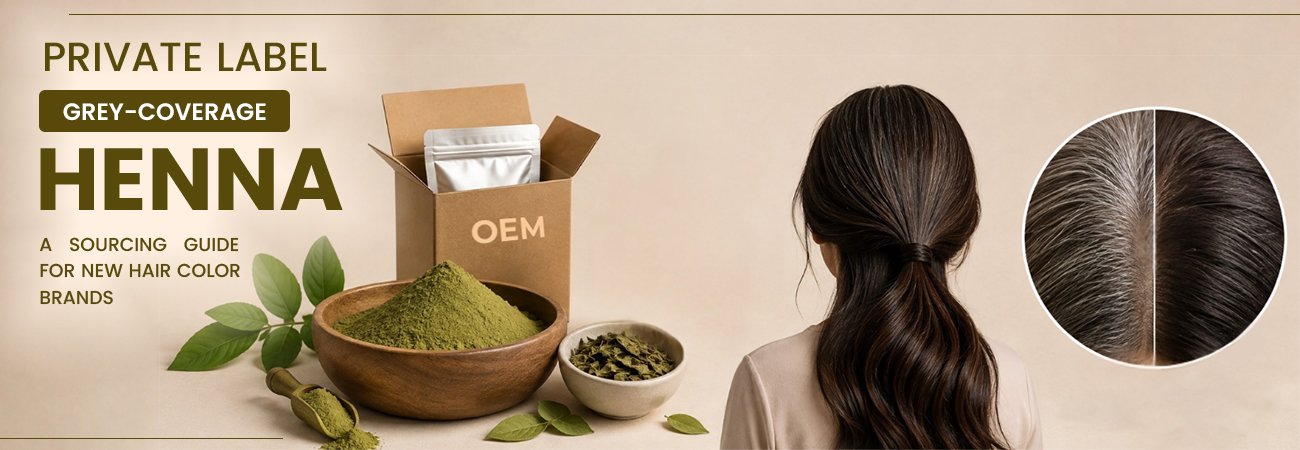
Launching a private label hair color line sounds simple on paper — pick a formula, slap your logo on the bottle, start selling. Then you actually start talking to manufacturers, and the questions pile up fast. Which base do you go with? How do you guarantee grey coverage that doesn’t fade orange in six weeks? What happens if your first batch doesn’t match the second? And if you’re leaning toward a natural or herbal positioning, how do you make sure the manufacturer you pick can actually deliver on that promise instead of just printing it on a label?
If you’re building a new hair color brand around grey coverage specifically — which is where most private label demand sits right now, given how many customers are actively avoiding ammonia and PPD-heavy chemical dyes — henna-based formulations deserve a serious look. Not as a trendy add-on, but as the actual base of your product. Here’s what that decision involves, and what to check before you commit to a manufacturer.
Grey hair is structurally different from pigmented hair. It has less melanin, a smoother cuticle, and it resists dye penetration in ways that regular hair doesn’t. That’s exactly why so many “natural” hair color products on the market quietly disappoint — they cover grey fine on hair with some pigment left, then fall apart on hair that’s gone fully white or silver.
This is where the manufacturer you choose actually matters, not just the ingredient list. A private label partner who understands lawsone concentration — the natural dye compound in henna — and how it interacts with different grey percentages can formulate something that holds up. A partner who’s just repackaging a generic henna blend usually can’t tell you why their formula performs differently on 30% grey versus 80% grey hair, because they’ve never had to test it that specifically.
If you’re entering the market now, in a landscape where “clean beauty” and “free-from” claims are under real scrutiny, henna gives you something synthetic dyes structurally can’t: an ingredient story that’s actually true.
For a brand launching fresh, that combination — real grey coverage, a defensible ingredient claim, and formulation flexibility — is a stronger foundation than most synthetic alternatives, especially with buyers increasingly reading ingredient panels before checkout.
Not every henna supplier is equipped to run a real private label program. Here’s what separates the ones who are from the ones who’ll leave you troubleshooting your own supply chain six months in.
1. In-house formulation, not just repackaging. Ask directly whether they formulate the blend themselves or buy a pre-made base and repackage it under your name. A manufacturer with real formulation control can adjust lawsone concentration, particle fineness, and herbal ratios to hit a specific grey-coverage target — a repackager can’t touch any of that.
2. Batch-to-batch consistency, backed by testing. Ask for lab reports on lawsone percentage and moisture content across multiple batches, not just one sample. Inconsistent henna is the single biggest cause of customer complaints in private label hair color — a shade that works beautifully in your launch batch and disappoints by batch three.
3. Willingness to run small-batch trials before your full order. A manufacturer confident in their process will let you test a trial batch, get it evaluated on real grey hair, and adjust the formula before you commit to bulk production. If a supplier pushes you straight to a large MOQ with no trial option, that’s worth questioning.
4. Custom packaging and labeling support. Private label means your branding, not theirs. Confirm they can produce unbranded or custom-labeled packaging, support your artwork specs, and handle the compliance labeling required for your target market (ingredient listing format differs between the US, UK, and EU).
5. Export documentation experience. If you’re importing from India, your manufacturer needs to actually understand phytosanitary certificates, country-specific cosmetic compliance, and customs documentation — not just say yes and figure it out after your PO is signed.
6. Straight answers about origin. Ask where the henna leaf itself comes from. Sojat, Rajasthan is the region most associated with naturally high-lawsone henna and carries GI (Geographical Indication) recognition — a manufacturer sourcing from there and willing to document it gives your brand a real origin story, not a vague “sourced in India” line.
Kirpal Export Overseas (KEO) is a Sojat, Rajasthan-based henna hair color manufacturer with the kind of in-house control that private label brands actually need — Sojat-origin, GI-tagged henna leaf, processed and formulated on-site rather than repackaged from someone else’s stock, with BIS/IS 11142-aligned testing behind it.
For a brand building specifically around grey coverage, that matters in a very practical way: KEO’s formulation team works with lawsone concentration and herbal blend ratios (amla, shikakai, bhringraj, hibiscus) to develop grey-coverage performance that holds up across different starting grey percentages, not just a generic one-size formula. KEO supports private label and OEM programs end-to-end — from trial batches through custom packaging to export documentation for buyers in the UK, USA, UAE, Germany, and Australia — which is exactly the kind of full-cycle support a new hair color brand needs when you don’t yet have your own manufacturing relationships built out.
If you’re serious about launching a grey-coverage hair color line built on a real herbal formula rather than a synthetic base with a “natural-inspired” label, working with an established henna hair color manufacturer like KEO gives you both the ingredient integrity and the production reliability a new brand can’t afford to compromise on.
Building a private label hair color brand around grey coverage is a genuinely strong market position right now, but only if the formula actually performs and the ingredient story is real. Henna gives you both, provided you’re sourcing from a manufacturer who formulates in-house, tests consistently, and can prove where the raw material actually comes from. Ask for trial batches, ask for lab reports, and don’t sign a bulk order until you’ve seen both.
Q: How long does it take to develop a private label henna hair color formula? It depends on how much customization you need. A standard formulation adjustment can move faster, but if you want a specific grey-coverage target or a custom herbal blend, expect a trial-and-refinement process before you lock in production.
Q: What’s the typical minimum order quantity for private label henna hair color? This varies by manufacturer and formulation complexity. It’s worth asking directly and negotiating a smaller trial run before committing to full MOQ, especially for a first order.
Q: Does henna hair color actually cover grey hair as well as chemical dyes? Yes, when the formulation is done correctly. The key variable is lawsone concentration and how well the manufacturer has tuned the blend for higher-grey-percentage hair — this is exactly why manufacturer expertise matters more than the ingredient list alone.
Q: Can henna hair color be marketed as PPD-free and ammonia-free? Pure henna and properly formulated herbal blends are naturally free of PPD and ammonia, which is one of the strongest selling points for brands positioning against synthetic dye allergy concerns. Always verify the exact formulation with your manufacturer before making label claims.
Q: Why does the origin of the henna leaf matter for a private label brand? Origin affects both quality and your brand story. Sojat-origin, GI-tagged henna is associated with naturally higher lawsone content, and being able to document that origin gives your brand a credible, verifiable claim rather than a generic “natural” label.
Every henna powder supplier claims to sell the “purest” product on the market. Walk through…
Walk into any natural hair care store, or scroll through a beauty forum for five…
If you’re a UK-based salon chain, hair color brand, or distributor trying to source henna…
Beauty trends move fast, and most of them disappear just as quickly. A new “miracle”…