Call/WhatsApp: +91-9811618013, +91-9810306077
Email: keohenna@gmail.com, kirpaloverseas@gmail.com
Email: keohenna@gmail.com, kirpaloverseas@gmail.com




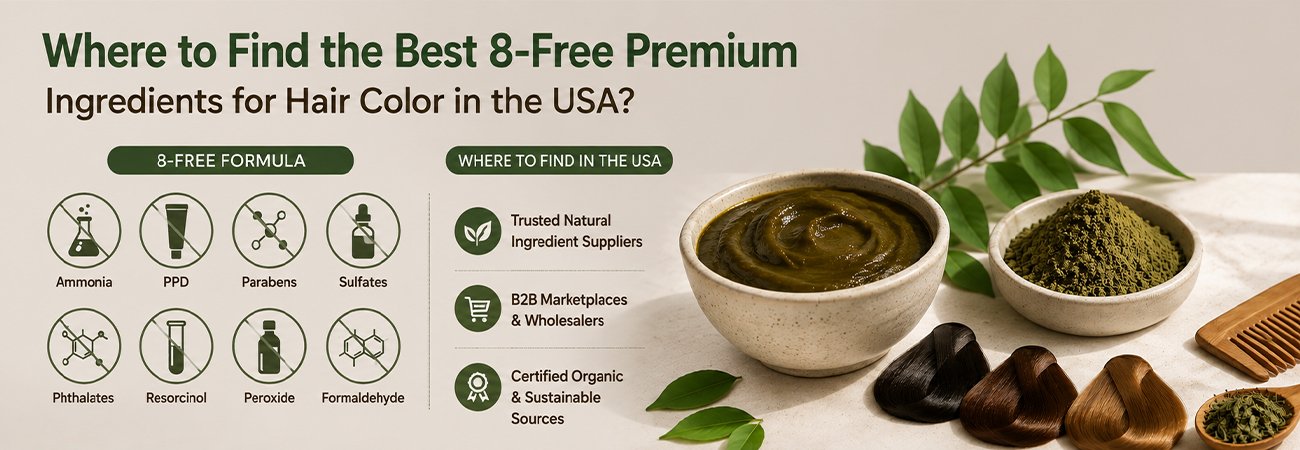
If you’ve spent any time formulating or sourcing for a hair color brand in the US market lately, you’ve probably noticed the word “8-free” popping up everywhere — on ingredient decks, on Instagram ads, on the back of bottles at Sephora and Ulta. Buyers ask for it. Formulators chase it. And honestly, most of the sourcing conversations around it end up in the same place: a long list of chemicals to avoid, and a much shorter, murkier list of what’s actually supposed to replace them.
That second part is where things get interesting, and it’s also where a lot of brands get stuck.
Being “free from” eight harsh chemicals is only half the job. The real question — the one buyers, private label brands, and salon-focused lines actually need answered — is what you use instead. What ingredient does the coloring? What conditions the hair afterward? What keeps the formula stable, shelf-safe, and effective without quietly smuggling one of those eight chemicals back in through a different name?
This is where premium, herb-based ingredients — and henna specifically — have been quietly doing the heavy lifting for centuries, long before “clean beauty” became a marketing category.
Before getting into sourcing, it’s worth being precise about the term, because it gets used loosely.
An 8-free hair color formula is typically free from:
Each of these earns its place on the “avoid” list for a reason. Ammonia and peroxide are what force conventional dye into the hair shaft, and they’re also what leave hair dry, porous, and prone to breakage over repeated use. PPD and resorcinol are common triggers for scalp allergies and contact dermatitis — a genuine safety concern, not just a marketing angle. Parabens and phthalates raise endocrine-disruption questions that a growing number of US consumers simply won’t accept anymore. Sulfates strip color faster than almost anything else you could put in a bottle. And formaldehyde-releasers are the kind of ingredient that looks fine on a spec sheet until someone reads the fine print.
Knowing the list is easy. Building a formula that still performs — that colors evenly, covers grey, and doesn’t fade in three washes — without any of them is the actual challenge.
US demand for clean, non-toxic hair color hasn’t slowed down — if anything, it’s accelerated. Retailers are asking suppliers for full ingredient transparency before they’ll even list a product. Private label buyers are specifically searching for “8-free” and “ammonia-free” formulations because their own customers are asking pointed questions about what’s in the box.
At the same time, a lot of what gets marketed as “clean” in the US is really just conventional dye chemistry with a few of the worst offenders swapped out — ammonia-free, say, but still built around synthetic dye intermediates and peroxide developers. That’s not nothing, but it’s not the same as a formula built from genuinely natural colorants.
That gap is exactly where herbal and henna-based ingredients earn their premium positioning.
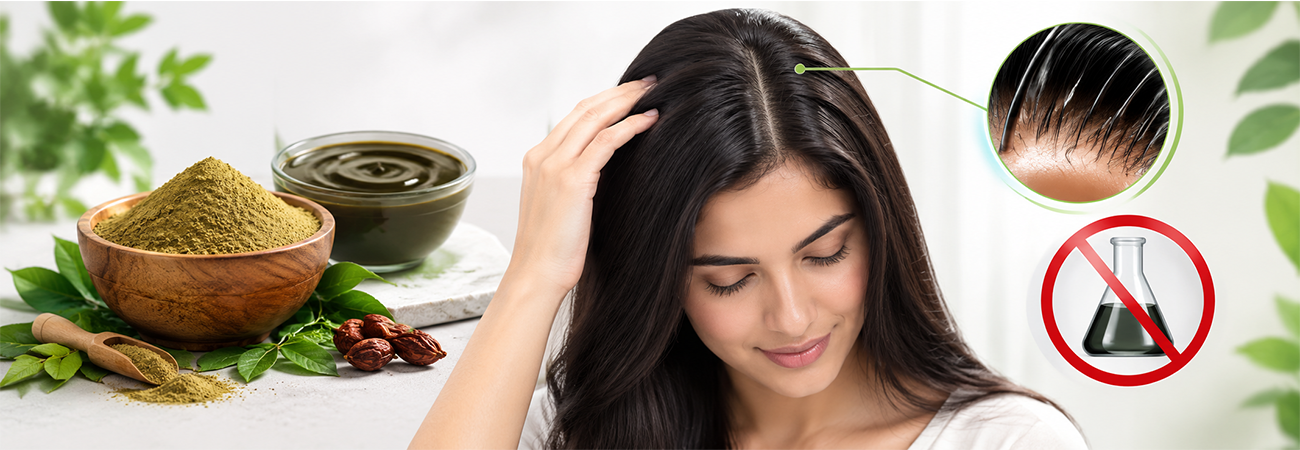
Henna is the backbone ingredient here, and for good reason. It’s a plant-derived colorant that deposits pigment onto the hair shaft through a natural staining process, not through chemical penetration and oxidation. No ammonia needed to open the cuticle. No peroxide needed to develop the shade. The lawsone molecule in henna binds directly to keratin, which is also why henna-colored hair tends to feel stronger and glossier over time rather than progressively more damaged.
Quality varies enormously here, though. Henna grown and processed in Sojat, Rajasthan — the region most closely associated with high-lawsone-content henna worldwide — is generally considered the benchmark for color payoff and consistency. Sourcing from that origin, with proper BIS/IS 11142 quality certification, is one of the clearest ways a US brand can back up an “8-free” or “natural” claim with something verifiable rather than just a label.
Where henna gives you warm reds and coppers, indigo is what makes deeper browns and blacks possible without synthetic dye. Combined with henna in a two-step or single-step blend, indigo lets formulators hit a much wider shade range — including the darker tones that a lot of “natural” hair color brands historically struggled to deliver convincingly.
Amla is less about color and more about performance. It’s rich in vitamin C and tannins, and it’s traditionally used to strengthen hair, reduce breakage, and support scalp health. In an 8-free formula, amla often does double duty as both a conditioning agent and a mild natural preservative-support ingredient, reducing reliance on synthetic stabilizers.
Shikakai (Acacia concinna) is a gentle, naturally saponin-rich cleanser that’s been used for generations as a scalp-friendly alternative to sulfate shampoos. In a hair color product line, it shows up in pre-treatment or complementary care products, reinforcing the sulfate-free positioning across an entire product family rather than just the color itself.
Known in Ayurvedic tradition as one of the most effective herbs for hair growth support, bhringraj is increasingly showing up in premium herbal hair color blends as a value-add ingredient — something that lets a brand talk about hair health benefits, not just color, on the product page.
Brahmi is another Ayurvedic staple, typically included for scalp nourishment and to support the overall “hair care meets hair color” positioning that a lot of premium US brands are leaning into. Consumers increasingly want their hair color to do more than just cover grey — they want it to leave hair in better condition than before.
Hibiscus extract adds shine and softness and is frequently paired with henna and indigo blends specifically to counteract the slight dryness that pure henna can sometimes cause on its own. It’s a small addition with a noticeable finishing effect.
For brands that want the conditioning benefits of henna without adding red or copper tones — useful for blondes or for pure black/brown formulations — cassia obovata is the go-to. It’s often blended into multi-herb formulas as the “base” ingredient that other botanicals build color on top of.
Put together, a premium 8-free hair color line built around these ingredients typically looks something like: a henna-and-indigo base for color deposition, amla and hibiscus for conditioning and shine, shikakai in the accompanying wash products, and bhringraj or brahmi as functional actives that support the “healthier hair, not just covered hair” claim on packaging.
The result is a formula where “free from ammonia, PPD, parabens, sulfates, phthalates, resorcinol, peroxide, and formaldehyde” isn’t just a claim on the box — it’s a description of what’s structurally true about the product, because none of those chemicals were ever needed to make it work in the first place.
Here’s the honest part of this conversation: finding a supplier who lists these ingredients is easy. IndiaMART and Alibaba are full of them. Finding a supplier who can actually back up lawsone content, BIS certification, batch consistency, and export documentation at commercial volume is a much smaller list.
This is the gap Kirpal Export Overseas (KEO) has spent years building around. Based in Sojat, Rajasthan — the geographic heart of premium henna cultivation — KEO manufactures and exports henna powder and herbal hair color ingredients directly to private label brands, wholesale importers, and salon-focused product lines across the US, UK, UAE, Germany, and Australia. Under the Indalo brand and through direct B2B/OEM supply, KEO works with international buyers who need more than a bag of powder — they need lawsone-content transparency, IS 11142 quality standards, consistent batch-to-batch color performance, and export paperwork that doesn’t slow down customs.
For a US hair color brand building an 8-free product line around henna, indigo, amla, and the rest of this ingredient list, sourcing directly from a Sojat-based henna manufacturer like KEO — rather than through a reseller several steps removed from the actual farms and processing units — tends to be the difference between a formula that performs consistently batch after batch and one that doesn’t.
“8-free” is a useful shorthand, but it’s really a description of what a formula avoids, not what makes it work. The brands winning in the US clean hair color space right now are the ones who can talk just as confidently about what’s in the bottle — henna, indigo, amla, shikakai, bhringraj, brahmi, hibiscus, cassia — as they can about what’s been left out.
Get the ingredient sourcing right, from a supplier who can actually prove origin and quality, and the 8-free claim stops being a marketing line and starts being simply an accurate description of the product
1. What does “8-free” mean in hair color formulation? It means the product is formulated without ammonia, PPD, parabens, sulfates, phthalates, resorcinol, peroxide, and formaldehyde — the eight ingredients most commonly linked to scalp irritation, hair damage, and long-term chemical exposure concerns.
2. Can henna alone create a full 8-free color range? Henna covers warm reds and coppers well on its own, but it’s usually paired with indigo to achieve deeper browns and blacks, giving formulators a fuller shade range without synthetic dye.
3. Why does henna origin matter for hair color manufacturers? Lawsone content — the compound responsible for henna’s coloring power — varies significantly by growing region. Sojat, Rajasthan is widely regarded as producing the highest-quality, highest-lawsone henna used in premium hair color formulations.
4. Are herbal hair color ingredients suitable for private label brands? Yes. Ingredients like henna, indigo, amla, and shikakai are commonly used by private label and OEM hair color brands because they support 8-free, sulfate-free, and natural-positioning claims that resonate with today’s US consumers.
5. How can a US brand verify the quality of imported henna and herbal ingredients? Look for suppliers who provide BIS/IS 11142 certification, lawsone-content documentation, and consistent export paperwork — not just a product listing. Manufacturers based directly in Sojat, like Kirpal Export Overseas, can typically provide this level of traceability.
The patch test is the most boring step in hair colouring, and the one most…
Every natural hair color manufacturer eventually gets the same message from a buyer: “The black…
Look closely at a microbladed brow around the eighteen-month mark, and the story is usually…
A customer once told us something we still remember. She had been colouring her gray…